Explore structured digital volumes featuring synchronized video lectures, AI study guides, and chapter notes.

By Mukul Raina
Created by Mukul Raina (Senior Software Engineer & Tech Lead at Microsoft, Oxford MSc), this course uses a ride-sharing platform (Uber-like) as the primary case study to walk you through the complete system design interview process. It covers requirements scoping (functional/non-functional, graceful degradation, consistency tiers), capacity estimation (1.25M GPS writes/sec, ride requests, storage/bandwidth, peak-to-average scaling), high-level architecture (API Gateway vs WebSocket Gateway, Matching Service with spatial indexing, Pricing/Surge logic, Kafka event bus, service boundaries), data flow & state machine (ride matching E2E, trip state transitions, race conditions, latency budgets), database design (Database Per Service, PostGIS for geospatial, Redis for real-time positions, time-series location storage, geographic sharding, indexing strategies), and API design (REST endpoints, WebSocket events, JWT authentication, tiered rate limiting, pagination, versioning). The course includes interview frameworks (4-minute requirements, 2-minute estimation, 5-move database presentation) and common mistakes—equipping you to ace Uber/ride-sharing system design problems at FAANG and beyond.

By InterviewWithBunny
Master large-scale distributed architecture by tackling essential system design interview questions, from URL shorteners and global video streaming platforms to real-time chat applications and high-frequency trading engines. You will learn to architect resilient, high-performance systems by strategically applying core primitives like load balancers, distributed caches, sharding, and the CAP theorem through structured, real-world case studies.

By Gaurav Sen
Master the architectural blueprints of high-scale distributed systems. This comprehensive guide covers critical fundamentals from load balancing and consistent hashing to message queues, database sharding, and microservices. Through real-world case studies like Tinder, you will learn to design resilient, event-driven architectures, draft precise API contracts, perform capacity planning, and confidently ace your next system design interview.

By Akhil Sharma
Master the foundational architecture of modern distributed systems by breaking down core networking and security protocols. This definitive guide equips you to design scalable, resilient applications, taking you step-by-step through IP, TCP/UDP, HTTP, DNS, SSL/TLS, and advanced data serialization techniques to build robust backend infrastructures with absolute confidence.

By KodeKloud
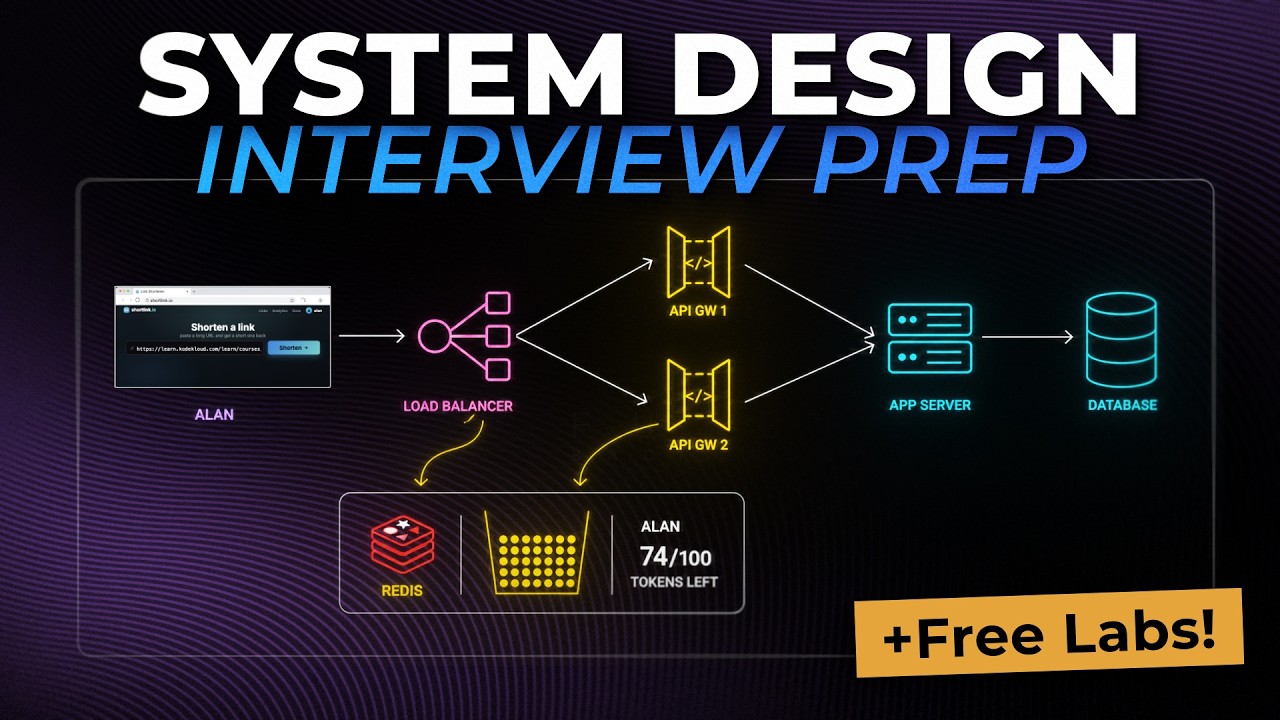
Master system design fundamentals and excel in technical interviews with a proven, reusable framework. Learn to deconstruct open-ended prompts, evaluate architectural trade-offs, and design scalable, high-availability solutions. Through hands-on challenges—including URL shorteners, distributed rate limiters, notification pipelines, and news feeds—you will gain the confidence to ace real-world engineering evaluations.

By Mukul Raina
Created by Mukul Raina (Senior Software Engineer & Tech Lead at Microsoft, Oxford MSc), this comprehensive course covers the full spectrum of microservices architecture—from mental models and decomposition strategies to communication patterns and distributed data management. It guides you through the monolith-to-microservices journey (including modular monoliths, the Strangler Fig pattern, and common anti-patterns), service boundary definition using Domain-Driven Design (Bounded Contexts, Aggregates, Ubiquitous Language), and inter-service communication (REST vs gRPC vs GraphQL, queues vs streams, timeout budgets, circuit breakers, bulkheads). The course also dives deep into data ownership (Database Per Service, CQRS, materialized views, eventual consistency, expand-contract migrations) and distributed transactions (Saga orchestration vs choreography, compensating transactions, Transactional Outbox, idempotency with Inbox pattern, dead-letter queues)—providing 47 patterns and 21 interview problems to help you ace microservices-focused system design interviews at FAANG and beyond.

By Mukul Raina
Created by Mukul Raina (Senior Software Engineer & Tech Lead at Microsoft, Oxford MSc), this course bridges the gap between interview-level design and real-world production systems operating at scale. It covers the five constraints that shape every system (availability, latency, cost, team structure, compliance) and dives deep into production-critical topics: safe database schema migrations (adding/removing/renaming columns, dual-write patterns, online schema tools like pt-osc/gh-ost), replication & consistency (leader-follower, failover, sagas, hot partitions), backup & disaster recovery (RPO/RTO, point-in-time recovery), caching (thundering herd, hot key problems, CDN invalidation), message queues (idempotency, exponential backoff with jitter, dead letter queues), reliability patterns (timeouts, retry budgets, circuit breakers, bulkheads, graceful degradation, load shedding), and health checks & chaos engineering—providing the production-depth thinking needed for Staff-level engineering roles.

By Mukul Raina
Created by Mukul Raina (Senior Software Engineer & Tech Lead at Microsoft, Oxford MSc), this course is a practical, interview-focused guide that walks you through the entire system design interview process—from gathering functional/non-functional requirements and capacity estimation (QPS, storage, bandwidth) to designing a full-scale social media feed system (Instagram-like). It covers database sharding, API design, feed generation algorithms (push vs pull vs hybrid), media storage with CDNs, auto-scaling, and real cost analysis (~$57M/month). The course also includes a dedicated section on interview strategy (45-minute breakdown, common mistakes, drawing diagrams) and an 8-week preparation plan to help you ace FAANG-level system design interviews.

By Mukul Raina
Created by Mukul Raina (Senior Software Engineer & Tech Lead at Microsoft, Oxford MSc), this course goes beyond fundamentals to prepare you for Staff-level and senior FAANG interviews with production-grade depth. It covers observability (logs, metrics, traces, RED/USE methods, SLIs/SLOs, distributed tracing with OpenTelemetry), safe deployment strategies (Blue-Green, Canary with Istio, Shadow deployments, automated rollbacks, feature flags), security (JWT/refresh tokens, RBAC vs ABAC, HashiCorp Vault, Zero Trust, mTLS, encryption, GDPR/PII handling), cost-aware design (right-sizing, spot instances, reserved capacity, storage lifecycle policies, caching ROI), global-scale multi-region architectures (active-active, CRDTs, anycast, data sovereignty), and incident management (blameless postmortems, circuit breakers, on-call best practices). It also includes real-world case studies (social feed, payment processing, real-time chat) and an interview playbook to help you signal production-depth thinking and avoid common red flags.

By Mukul Raina
Created by Mukul Raina (Senior Software Engineer & Tech Lead at Microsoft, Oxford MSc), this comprehensive course provides a complete foundation for system design interviews. It systematically covers everything from internet fundamentals (DNS, TCP/UDP, HTTP, TLS) and server architectures (monolith vs microservices) to databases (SQL vs NoSQL, indexing, sharding, replication), scaling strategies (vertical/horizontal, capacity estimation), caching (Redis, eviction policies), load balancing (algorithms, Layer 4 vs Layer 7), and CDNs—all backed by real-world case studies like Instagram, Netflix, and WhatsApp to prepare you for FAANG-level technical screens.